Why beech became the toy wood
European toymaking has run on beech for two centuries. The reason is technical rather than romantic. And beech has one serious flaw.
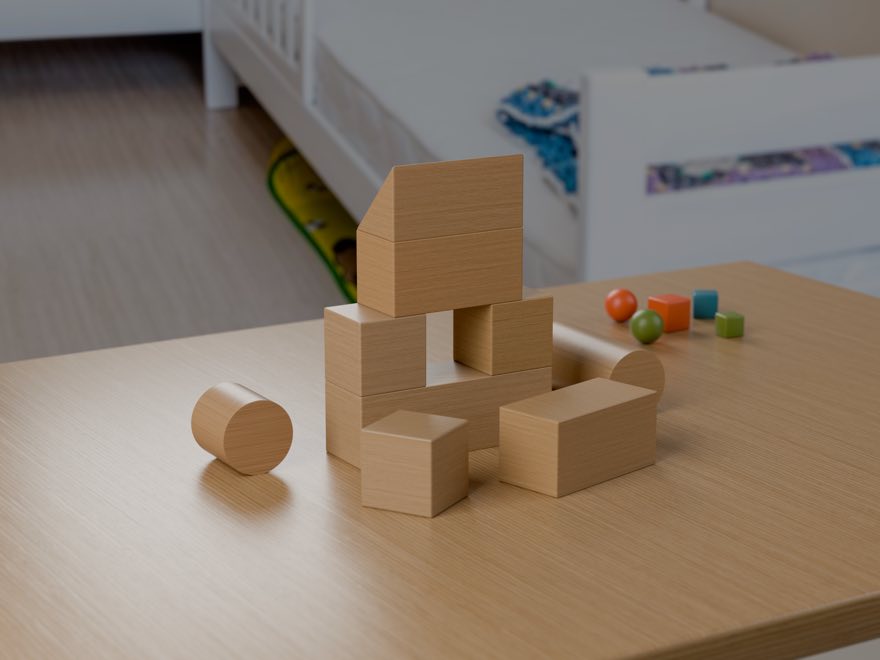
Beech is standard in toys because its pores are fine and closed, so it wears without splintering. It has no smell and no resin. It turns and steam bends beautifully. At 1,450 lbf it resists denting without burning tools. Its flaw is dimensional movement: it shifts noticeably as humidity changes.
Grimm’s, HABA, BRIO, Ostheimer. Look at the European wooden toy brands and the same species keeps appearing: beech. Tradition is part of it. It is not the main part.
Beech in numbers
European beech (Fagus sylvatica) has a Janka hardness of 1,450 lbf and a density of 710 kg/m³. The Oriental beech we use in Turkey (Fagus orientalis) sits in practically the same class: bending strength measured at 118 MPa.
A few species for comparison:
- Hornbeam: 1,630 lbf, about 12 percent harder. But it dries slowly, moves a lot while drying and blunts tools fast.
- Hard maple: 1,450 lbf, the same as beech, and dimensionally more stable. It does tend to burn at high spindle speeds.
- Birch: 1,210 lbf. Easy to work, the Scandinavian choice. Some boards tear out.
- Lime: 700 lbf. Ideal for carving, wrong for toys. A fingernail marks it.
The real reason is the pores
Beech is diffuse porous, meaning it has no large channels running along the grain. In ring porous species like oak and ash, open channels stay visible at the surface. On a toy that ends up in a mouth, that means two things: it traps dirt, and it can splinter.
The property that gets repeated most often about beech is this: it wears without splintering. A beech block used for years gets worn but does not raise fibres. That is the real reason toymaking settled on it.
The other technical reasons
No smell, no resin. Beech has no characteristic odour and nothing seeps out of it the way it does from pine. It does not irritate skin.
Outstanding in steam bending. One of beech’s rarer strengths, useful for wheels, beads and curved parts.
Clean on the lathe. At 710 kg/m³ it sits right in the ideal band for turning. That is why beads and wheels are made from it.
Abundant and cheap. Beech covers about 1.9 million hectares in Turkey, 8.5 percent of total forest area, the second most widespread broadleaf after oak. It grows on north facing slopes in the Black Sea and Marmara regions, between 700 and 1,200 metres.
The historical reason follows from that. In the Central European toymaking regions like the Erzgebirge and Thuringia, beech was simply the most available hardwood. The craft was built on whatever was at hand.
The flaw
Here we should be straight. Beech has a real weakness: high dimensional movement. Volumetric shrinkage is 17.9 percent and the tangential to radial ratio is 2.0. In the timber literature that number comes with the note “significant dimensional movement in service.”
In practice: the piece grows and shrinks noticeably as humidity changes. This matters in Istanbul, where outdoor air stays humid all year but a heated flat gets very dry in winter. We wrote about that separately.
There is a second flaw, but this one concerns the maker rather than the child. Beech dust is a sensitiser, and long unprotected exposure raises cancer risk. Dust extraction in the workshop is not optional.
What we use
Kiln dried Oriental beech from the Black Sea region. For critical parts like axles and thin shafts we are looking at hornbeam, because there the hardness difference earns its keep.
Steamed or unsteamed is still an open question for us. Steaming evens out the colour, which helps a brand that sells unpainted. But it lowers mechanical properties slightly, and on thin parts we would rather not give that up.
Faruk
I am building Masifico. I write these posts not as an expert but as someone who asked the same questions and wrote down what he found. If something here is wrong, tell me and I will fix it.
You might also like
What is actually on an unpainted toy
Unpainted does not mean bare. Something has to sit on the wood, and what that something is matters.