Choosing wooden toys by age
What works for a one year old bores a three year old. Here is what actually holds attention at each stage, how many pieces are enough, and what to check before you buy.
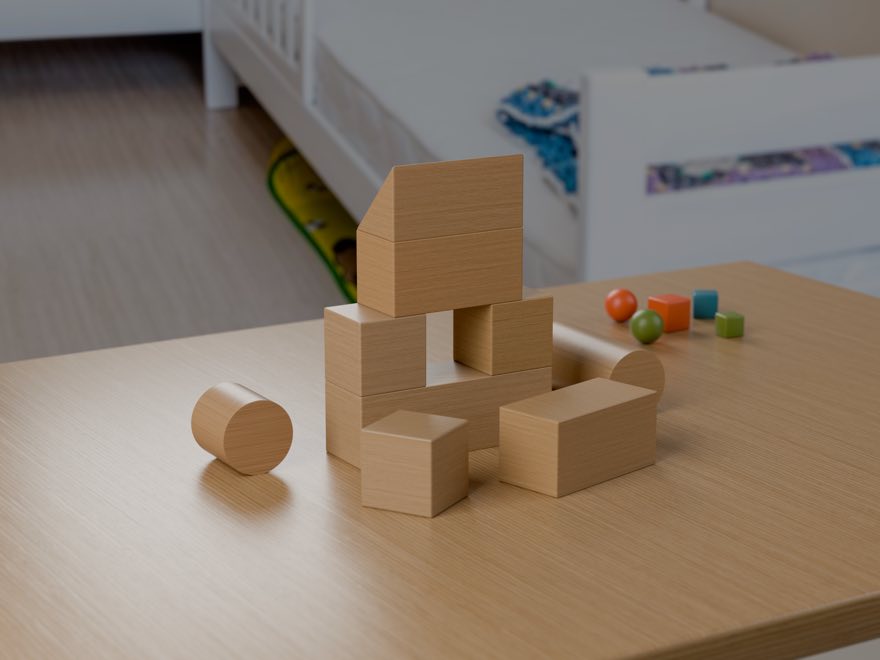
Under one, anything too large to fit in the mouth and made in one piece is enough. Between one and three, stacking and balancing start: few pieces, but chunky ones. After three comes building, so piece count matters more than size. Past six a toy becomes material for other games.
The question we hear most often is which toy suits which age. The ranges printed on boxes are broad, while in practice a single year changes everything. What follows is the simplified version of what we learned from our own tests and from watching children in nurseries.
Under one
At this stage toys go into the mouth more than into hands. So there is one rule: the piece must be too large to fit in the mouth, with nothing on it that can come loose. Unpainted wood helps here, because paint coming off stops being a question at all.
There is no point buying many pieces. Two or three good ones last for months.
One to three
The stacking and balancing age. A child discovers that things can go on top of each other, and then that they can be knocked down. Knocking down matters as much as stacking, because the first thing learned is why it fell.
Pieces need to be chunky enough to grip. Small hands cannot hold a thin piece, and a toy that cannot be held is a short game.
A practical test: if you cannot hold a piece comfortably between thumb and forefinger, it is too small for this age.
Three to six
The building age. Now there is a plan in the child’s head: a bridge, a garage, a tower, a house. Piece count starts to matter. Fewer than twenty pieces makes for a game that ends quickly.
Variety beats quantity of one shape. Cubes, long blocks, triangles and cylinders together multiply what can be built.
How many pieces are enough
| Age | What they do | Rough piece count |
|---|---|---|
| 0-1 | Holding, mouthing | 2-3 |
| 1-3 | Stacking, balancing | 8-12 |
| 3-6 | Building, storytelling | 20-30 |
| 6+ | Free design, collecting | 30 and up |
Six and older
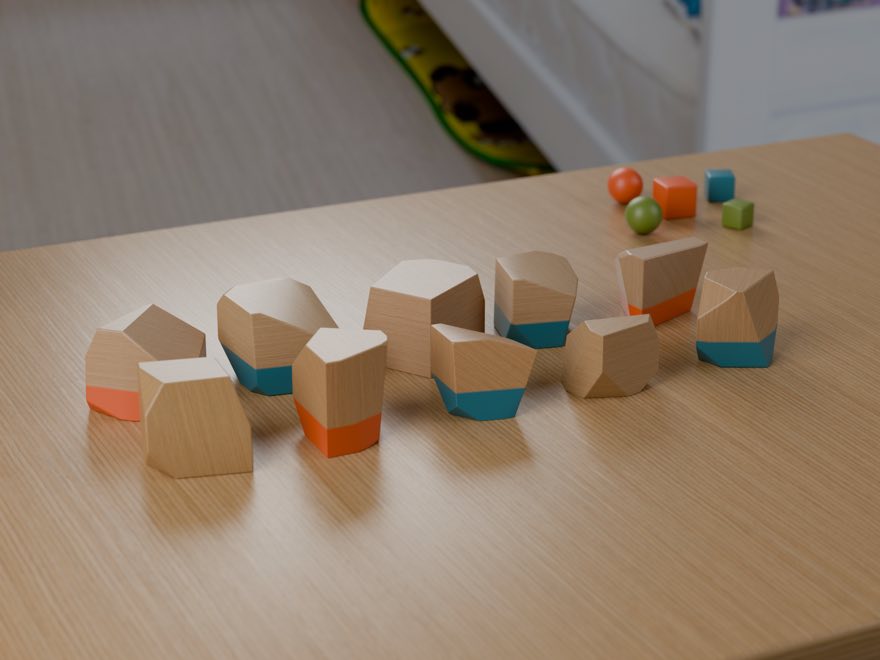
After this age a toy stops being a toy and becomes material. Blocks join other games, balance stones turn into a table top patience game. This is where good material pays off, because a toy that survived its first year can make it this far.
What to check in the shop
- Look at the cut edge. In solid wood the grain continues through the cut; in pressed board the edge looks dusty and flat.
- Pick it up. Of two pieces the same size, the heavier one is usually solid.
- Run a finger along the edges. A properly sanded edge does not catch.
- Smell it. A sharp chemical smell says something about the finish, and it is not good news.
Whether a toy is any good shows on the second day, when you see if the child comes back to it.
Common questions
How long do wooden toys last
Chosen well, into school years. Block sets tend to last longest, because the game gets rebuilt at every age.
Painted or unpainted
Either can be fine, as long as the paint is documented as suitable for toys. We prefer to leave ours bare.
What if it gets wet
Wiping with a damp cloth is fine. Soaking raises the grain, so wooden toys never go in the dishwasher.
Faruk
I am building Masifico. I write these posts not as an expert but as someone who asked the same questions and wrote down what he found. If something here is wrong, tell me and I will fix it.
You might also like
How to choose a secondhand wooden toy
This is where wood genuinely wins. It can be sanded, glued and have parts replaced.
Why wooden toys break
Most broken pieces come down to the same two mistakes. You can spot both in a shop with the toy in your hand.
The difference between four toys and sixteen
Awkward thing for a toy workshop to say: the strongest finding we have says children need fewer toys, not more.