Which claims about wooden toys actually hold up
It feels strange to take apart the marketing for the thing we are about to sell. Four claims have solid research behind them. Six do not.
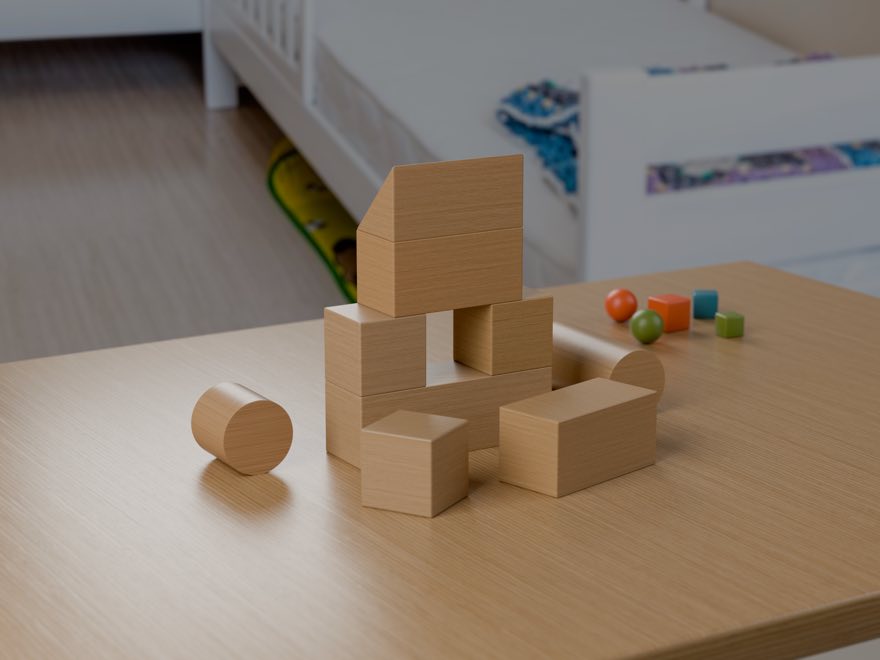
Four claims hold up: fewer toys produce deeper play, quiet toys produce more talk, open-ended construction toys raise play quality, and full Montessori practice shows measurable gains. Claims that wood is antibacterial or that it boosts creativity have no direct evidence.
A brand that sells wooden toys taking apart the claims made for wooden toys probably looks odd. But if we are going to defend a product, we need to know which reasons are load bearing. Otherwise the first serious question leaves us with nothing.
Here is the pattern that came out of the literature: most claims about the material are weak, and the claims about how a toy behaves are strong.
Four claims with solid evidence
Fewer toys produce deeper play
Dauch and colleagues, 2018, watched 36 toddlers between 18 and 30 months in two settings, one with four toys and one with sixteen. In the four toy setting children played longer with each toy and in more varied ways. Engagement per toy went up by roughly half.
There is an uncomfortable consequence for us in that. Buying a wooden toy to add to the pile works against this finding.
Quiet toys produce more talk
Anna Sosa’s 2016 study in JAMA Pediatrics recorded 26 parent and infant pairs at home. With electronic toys, parents used fewer words, responded less, and took fewer conversational turns. Content specific words, colours, shapes, animal names, dropped noticeably.
Worth noting: the comparison is electronic against traditional, not wood against plastic. A quiet plastic puzzle sits on the traditional side too.
Open-ended construction toys raise play quality
Trawick-Smith and colleagues, 2015, analysed 240 hours of video of 60 children playing with nine toys. The highest play quality scores went to hardwood blocks, wooden vehicles and animal figures.
The same study carries a warning. Scores varied with the child’s gender, socioeconomic background and ethnicity. There is no universal best toy.
Montessori practice shows measurable gains
A 2023 meta-analysis by Randolph and colleagues pooled 32 studies. The academic effect was 0.24, the non-academic effect 0.33. Small but real.
The limit matters here as well. That study measures Montessori education, not the effect of Montessori materials, and certainly not the effect of those materials being wooden.
Six claims without much behind them
“Wooden toys make children more creative.” We could not find a study comparing wooden and plastic versions of the same toy and measuring creativity or play duration. Experiments on block play tend to use wooden and plastic blocks together.
“Wood is antibacterial, so it is more hygienic for children.” This traces back to a 1994 food safety study on cutting boards. The findings are real, but they came from laboratory conditions, liquid inoculation and uncoated wood. Most toys are coated, ours included. No study has shown that wooden toys reduce infection in children.
“The texture and warmth of wood support development.” The closest evidence is a study of 18 young women showing short term physiological calming from touching wood. No children, no learning outcome.
“Wooden toys last for generations.” Life cycle data puts the average lifespan of a wooden toy at 7.29 years and a plastic one at 6.17. Less than a year apart. Exceptional cases exist, but the average says what it says.
“A faceless doll develops imagination.” The Waldorf reasoning is theoretical. We found no study measuring it.
“Froebel blocks gave birth to modernism.” Frank Lloyd Wright probably did play with Froebel blocks as a child. But he wrote that 55 years later, and he was very good at building his own myth. That is the only source.
So what is left
Quite a lot, actually. An honest list of reasons looks like this: quiet, open-ended, few in number, well made, repairable, and worth passing on secondhand.
None of those need the assumption that natural is better. Psychology has a name for that assumption: the naturalness bias. People choose the “natural” option even when told the two are chemically identical. Wooden toy marketing is largely built on it.
One more thing. A wooden toy is not automatically safer. Small part risk, coating chemistry and the splinter a broken piece leaves are all independent of material. Safety is a question of meeting a standard, not of choosing a material.
We make ours knowing this. We would rather sell them the same way.
Faruk
I am building Masifico. I write these posts not as an expert but as someone who asked the same questions and wrote down what he found. If something here is wrong, tell me and I will fix it.
You might also like
What the CE mark on a toy actually tells you
CE is not a quality award. It is the manufacturer's own declaration. Knowing that changes how you read a label.
Are wooden toys really more sustainable
The answer is yes, but less clearly than you would think. Life cycle studies also put wood last in one category.