The difference between four toys and sixteen
Awkward thing for a toy workshop to say: the strongest finding we have says children need fewer toys, not more.
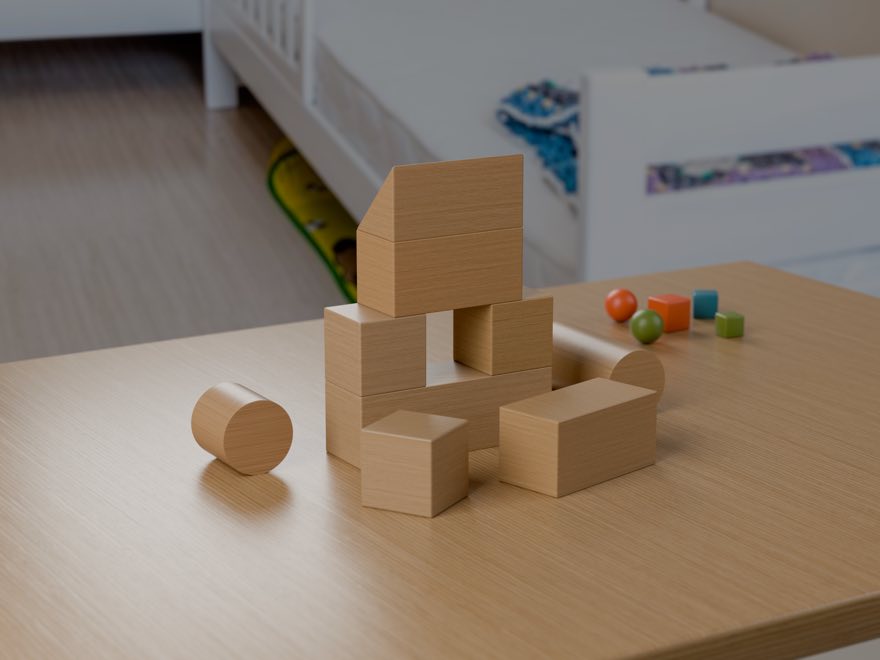
A 2018 study watched 36 toddlers in two settings, one with four toys and one with sixteen. With four toys, children played with each one roughly 1.5 times longer and in more varied ways. Reducing the number of toys increases the depth of play.
A workshop that makes wooden toys telling you to buy fewer toys is commercially stupid. But this is the most concrete experimental finding in the field, and staying quiet about it would be worse.
What the study did
Carly Dauch and colleagues published their work in Infant Behavior and Development in 2018. They observed 36 toddlers aged 18 to 30 months. Each child played in two settings: one with four toys, one with sixteen. The order was randomised, so some children met the small set first and some the large one.
The result: with four toys, children played with each one longer and in more varied ways. Engagement per toy rose by roughly half. Play episodes lasted longer.
Why this happens
The study does not measure the mechanism, but the plausible explanation is this. With sixteen toys the child is constantly choosing. Every new object pulls attention and the play in hand gets abandoned. With four, when a toy runs out of obvious uses the child has to turn it into something else. The block becomes a tower, then a bridge, then a telephone.
The longer a child stays with one toy, the less it matters what that toy actually is.
The limits
We have to say this part. The sample is small: 36 children. The setting is a laboratory, not a home. One session, no long term developmental outcome. So it does not say that children raised with fewer toys become more creative. What it says is narrower: the same child plays more deeply in the smaller set.
Even so, it is the best experimental support in the area. For comparison, the claim that wooden toys increase creativity does not have evidence at even this level.
What to do with it
There are practical things here, and none of them require buying anything.
- Rotate. Put most of the toys away and leave a few out. Swap every few weeks. A toy that comes back after a month gets greeted like a new one.
- Simplify the room. The number of toys in sight matters more than the number of toys in the house.
- When gifts arrive. Opening everything at once after a birthday works less well than queuing them.
- When buying. “What will this replace?” is a more useful question than “is this a good toy?”
What it means for us
Two things. First, we should make a small number of toys that stay interesting for a long time, rather than many small ones. Second, we will not build a range that works on completion logic. No counters, no series, no pressure of a missing piece.
It is a strange goal for a toy brand, but here it is: raise the quality of play in a house without raising the number of toys in it.
Source: Dauch, C. et al. (2018). The influence of the number of toys in the environment on toddlers’ play. Infant Behavior and Development, 50, 78-87.
Faruk
I am building Masifico. I write these posts not as an expert but as someone who asked the same questions and wrote down what he found. If something here is wrong, tell me and I will fix it.
You might also like
How to choose a secondhand wooden toy
This is where wood genuinely wins. It can be sanded, glued and have parts replaced.
Why wooden toys break
Most broken pieces come down to the same two mistakes. You can spot both in a shop with the toy in your hand.
Choosing wooden toys by age
What works for a one year old bores a three year old. Here is what actually holds attention at each stage, how many pieces are enough, and what to check before you buy.